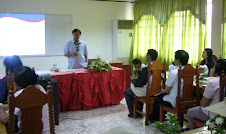
Dr.Camilo Polinga, project manager of iSchools-CvSU, together with presidents and ICT coordinators of different state colleges and universities in the country meet at the Development Academy of the Philippines Convention Center in Tagaytay City on May 26-28, 2008 for the project briefing on iSchools 2007.
The activities include project orientation, meetings and workshops in the implementation of the project for the new batch of beneficiary public high schools.
Showing posts with label DAP. Show all posts
Showing posts with label DAP. Show all posts
May 27, 2008
SUC presidents, ICT coordinators attend project briefing

Dec 11, 2007
iSchools: Issues and Concerns
You cannot love something that you do not know. It is for this reason that all the stakeholders of the iSchools Project of the Commission on Information and Communications Technology were informed about the project during the community mobilization by the partner state universities and colleges.
The principals, presidents of parent-teacher-community associations and members of the school board of the various recipient schools were oriented on the project objectives and the duties and responsibilities of concerned institutions.
Despite these orientation activities, still, some issues and concerns were raised during the three-day Sustainability Planning Workshop held at the Development Academy of the Philippines Convention Center, Tagaytay City.
Project management
“Is school visitation included in the timetable?,” asked a representative from Batangas State University Laboratory School. Project Manager Camilo Polinga of CvSU replied that school visitations may be announced or unannounced and there would be a monitoring system to be followed.
“Are iSchools beneficiaries allowed to acquire additional units for internet connection?,” asked the Caridad National High School representative. PM Polinga agreed that iSchools beneficiaries are allowed to acquire additional units, but if the units will be connected to the network, speed might be affected. Therefore, proper coordination with the PMO shall be done.
Technical issues
“Is it possible to have two operating systems in each unit?”, inquired one ICT coordinator. “Will the CICT consider the use of a licensed software since would-be users in the community are more knowledgeable in using licensed software than open source software.”
Ms. Melizza Tan of CICT replied that the use of two operating systems would not be allowed. She added that the purpose of using open source software is to maximize the budget in acquiring the number of computer units, since open source software is for free. She also reminded the schools that as partners of CICT, it is their responsibility to provide training in the use of open source software.
Where do we go from here?
There may still be doubts and questions on how the project will proceed but the stakeholders realized the significance of the project and expressed their commitment to be an active partner in bridging the digital divide in their respective communities.
Nov 16, 2007
CvSU conducts Sustainability Planning Workshop
Cavite State University coordinated the iSchools' Sustainability Planning Workshop for the Southern Luzon Cluster on October 22-24, 2007 at the Development Academy of the Philippines, Tagaytay City.
The workshop was participated in by 100 principals, parents-teachers-community association (PTCA) presidents and school board members of public high schools.
Workshop inputs
The sessions were:
• CICT and iSchools Project Briefing
• iSchools CeC Models
• Linking the School and the Community
• Technical Issues in Maintaining an Internet Lab
• Cost of Maintaining an Internet Lab
• Business Planning
Workshop outputs
The participants determined the needs of their respective communities using an appraisal checklist, chose the model to adopt based on their needs, and prepared their business plan based on the model selected. The open forum clarified the issues raised by the stakeholders.
The Southern Luzon Cluster has 42 recipient public high schools assigned to three partner state universities and colleges: CvSU, Batangas State University and Laguna University.
Subscribe to:
Posts (Atom)